 Skip-the-line available
 What to See Inside Sintra National Palace
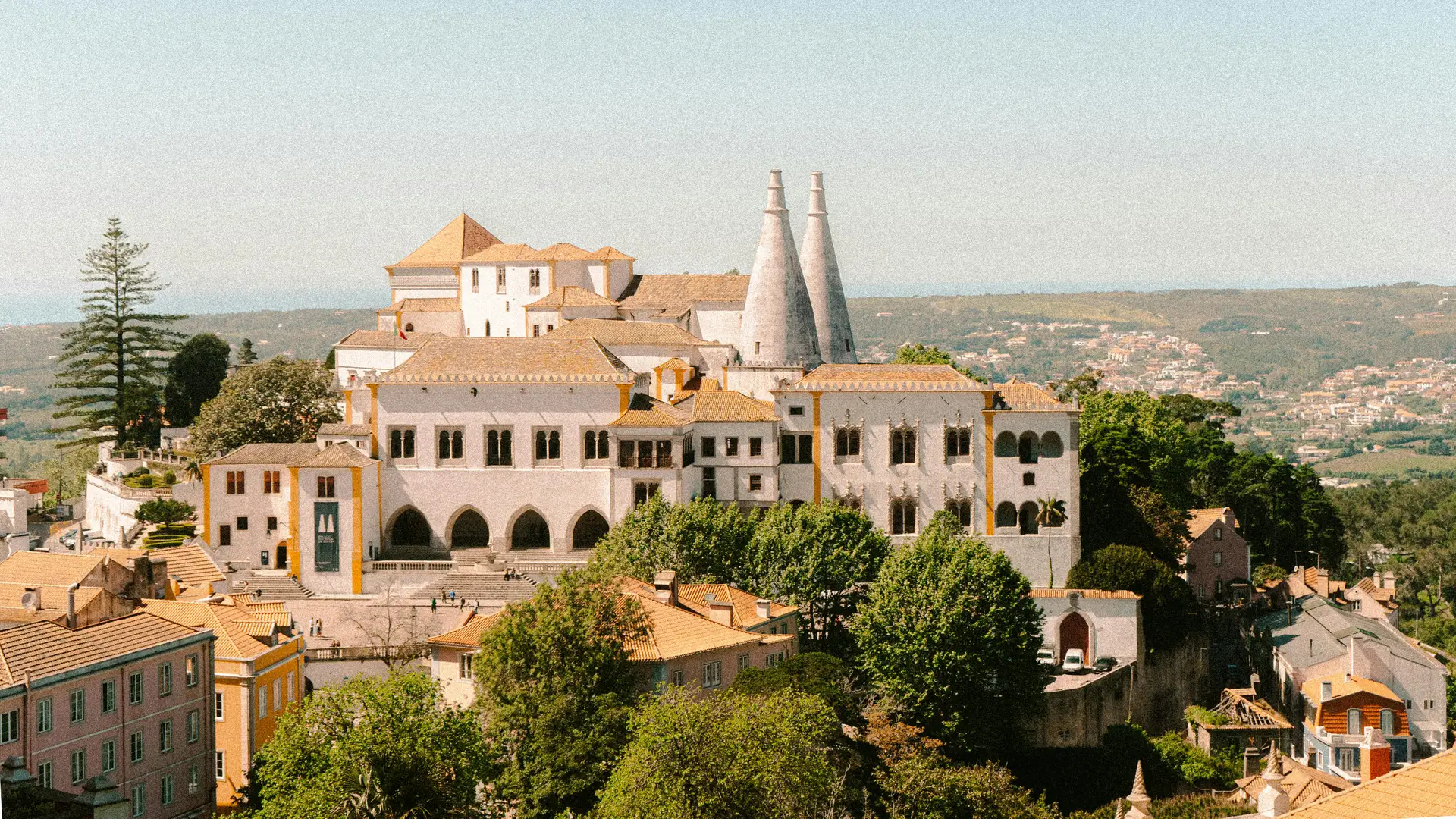
Palácio Nacional de Sintra rewards slow, attentive looking. From the outside it announces itself with the unmistakable silhouette of two great white conical chimneys, 33 metres tall, but the deeper pleasure is inside, where six centuries of Portuguese royal life are written into the painted ceilings, the Hispano-Moorish azulejo tilework, and the heraldic galleries. Most visitors spend 60 to 90 minutes within the palace; this concierge guide walks you through the rooms that genuinely deserve your time and explains what to look for in each. We focus on the Swan Room (Sala dos Cisnes), the Magpie Room (Sala das Pegas), the Coats of Arms Room (Sala dos Brasões), the medieval kitchen with its twin chimneys, and the Manueline tile galleries and royal chapel. By the time you re-emerge into the village square, you will have seen the layered making of a Portuguese royal residence whose architectural conversation spans the Moorish, medieval, Manueline and Romantic eras.
The Swan Room and the Magpie Room: painted-ceiling masterpieces
The Swan Room (Sala dos Cisnes) takes its name from the 27 swans painted across its late-14th-century wooden ceiling, each in a slightly different posture, encircled with gilt collars in a frieze of considerable visual rhythm. The ceiling has been linked by tradition to the marriage of King João I of Portugal to Queen Philippa of Lancaster in 1387, and one popular reading interprets the swans as a wedding gift evoking Philippa's English lineage and the symbolic association of swans with English nobility. Whether the connection to Philippa's wedding is documented or traditional, the room is undeniably one of the finest painted ceilings in Iberian medieval art, and it served as the principal state hall for receptions and banquets across multiple reigns. Stand back to take in the whole rhythm of swans before stepping closer — no two birds are identical.
The adjoining Magpie Room (Sala das Pegas) carries a ceiling painted with magpies, each holding in its beak a banner inscribed with the motto Por Bem, meaning roughly for the best or with good intent. The traditional legend says that King João I was caught by Queen Philippa kissing a lady-in-waiting; the queen's response was simply Por Bem, suggesting the kiss had been innocent; and the king, half rueful and half amused at the gossiping court ladies who had reported the kiss, ordered the ceiling painted with as many magpies as there were chattering women, each clutching the queen's phrase. Whether the story is literal history or a much later courtly tradition, the Por Bem motto is genuinely there above your head, and the room's atmosphere is exactly that of a private joke remembered for 600 years.
Sala dos Brasões — the Coats of Arms Room
The Coats of Arms Room is the great heraldic statement of the palace, built in the early 16th century under King Manuel I in a domed octagonal plan. Its painted wooden ceiling carries the royal coat of arms of Portugal at the centre, surrounded by 71 shields of Portuguese noble families, with the king's own arms positioned at the apex of the hierarchy. The lower walls are clad in striking blue-and-white 18th-century azulejo tile panels depicting hunting and pastoral scenes — added during a later refurbishment — so the room reads as a layered architectural document of Portuguese identity from the Manueline through the Baroque.
Look up first to read the heraldic order of noble Portugal as it existed under Manuel I; then look around to enjoy the secular leisure subjects of the later azulejos. The contrast between dynastic ceiling and worldly walls is part of the room's particular power. The octagonal plan itself is unusual in Portuguese royal architecture of the period, and the room sits structurally at the junction between the older medieval cores of the palace and the Manueline-era expansion João II and Manuel I commissioned at the turn of the 16th century. Take your time here — the Coats of Arms Room repays the slowest visit of any room in the palace, and most visitors rush it.
The medieval kitchen and the twin chimneys
The kitchen of Sintra National Palace is one of the most architecturally theatrical service spaces in Europe. Two enormous conical chimneys, 33 metres tall, rise from the cooking floor and dominate the entire silhouette of the palace from outside the building. Inside, the visitor stands beneath the open cones and looks up through smoke-darkened brick into open daylight — a functional engineering solution to the problem of venting the smoke of multiple simultaneous royal feasts, but executed at a scale that is almost industrial-sublime. Long copper batterie de cuisine, cast iron grills, stone preparation surfaces and great hearths fill the floor space, evoking the level of royal hospitality the palace was built to deliver.
The kitchen is a popular photography spot near the end of the standard visitor route — allow time to look up properly. The two chimneys are part of the palace's most recognisable exterior signature, visible from the train approach and from the village square below, and they have served for centuries as the symbolic image of Sintra in Portuguese tourism imagery. Their scale is hard to grasp from outside the building; inside, standing on the kitchen floor and looking straight up through the cone is the only place the engineering reveals itself fully. Bring a wide-angle lens or step well back from the centre to capture the verticality.
Royal chapel and Manueline tile galleries
The royal chapel preserves a small, intimate space of late-medieval devotion, with painted geometric ceiling motifs that echo Moorish tradition and an inlaid mosaic floor that rewards close attention. The scale is deliberately human, the lighting low and contemplative, and the chapel sits structurally close to the private royal apartments rather than as a public state space. It was used by successive Portuguese sovereigns and their households across centuries of continuous royal occupation, and small alterations across periods are visible to attentive eyes — a Romantic-era restoration here, a Manueline carving there, an older Hispano-Moorish floor underneath.
From the chapel, the visit threads through galleries lined with some of the finest Hispano-Moorish azulejo tilework in Portugal — earlier than the better-known Lisbon blue-and-white tradition, these tiles are polychromatic, geometric, and laid in alternating tessellated patterns of green, blue, ochre and white that were a clear inheritance from the Iberian peninsula's Islamic centuries. The tiles in these galleries are the architectural memory of the building's earliest pre-royal occupation under the Moors, and seeing them alongside the painted heraldic ceilings above is precisely the cross-cultural layering that makes Sintra National Palace unlike any other royal house in Europe. Pause in the galleries longer than the standard route suggests.
Frequently asked
What is the Swan Room famous for?
The 27 swans painted across its late-14th-century wooden ceiling, traditionally associated with the marriage of King João I to Queen Philippa of Lancaster in 1387.
What is the story behind the Magpie Room?
The ceiling is painted with magpies each holding a banner reading Por Bem (for the best), tied to a legend about King João I and Queen Philippa of Lancaster after a courtly kiss incident.
How tall are the twin chimneys?
Each conical chimney rises 33 metres above the medieval kitchen and dominates the palace's silhouette in the Sintra village skyline.
How many coats of arms are in the Coats of Arms Room?
71 shields of Portuguese noble families surround the central royal arms, in an octagonal domed plan built under King Manuel I.
How long does a typical visit inside take?
Most visitors spend 60 to 90 minutes inside, which is enough to enjoy the main rooms at a relaxed pace.
Is photography allowed inside?
Photography for personal use is generally permitted in most rooms without flash or tripods. Specific rules may apply during temporary exhibitions.
Are the tiles original?
Many of the Hispano-Moorish tile galleries preserve original medieval and early-modern panels, with later additions in the Coats of Arms Room and elsewhere from the 18th century.
What architectural styles are visible?
Moorish, medieval Portuguese, Manueline-mudéjar, and later Baroque additions — a layered conversation spanning six centuries.
Is there an audio guide?
Yes, audio guides are available from the operator on site, covering the main rooms in multiple languages.
Which room is the best for photography?
The medieval kitchen looking up through the twin chimneys is the most theatrical photograph; the Swan and Magpie Rooms are the most rewarding ceiling shots.