 Skip-the-line available
 Sintra National Palace vs Pena Palace
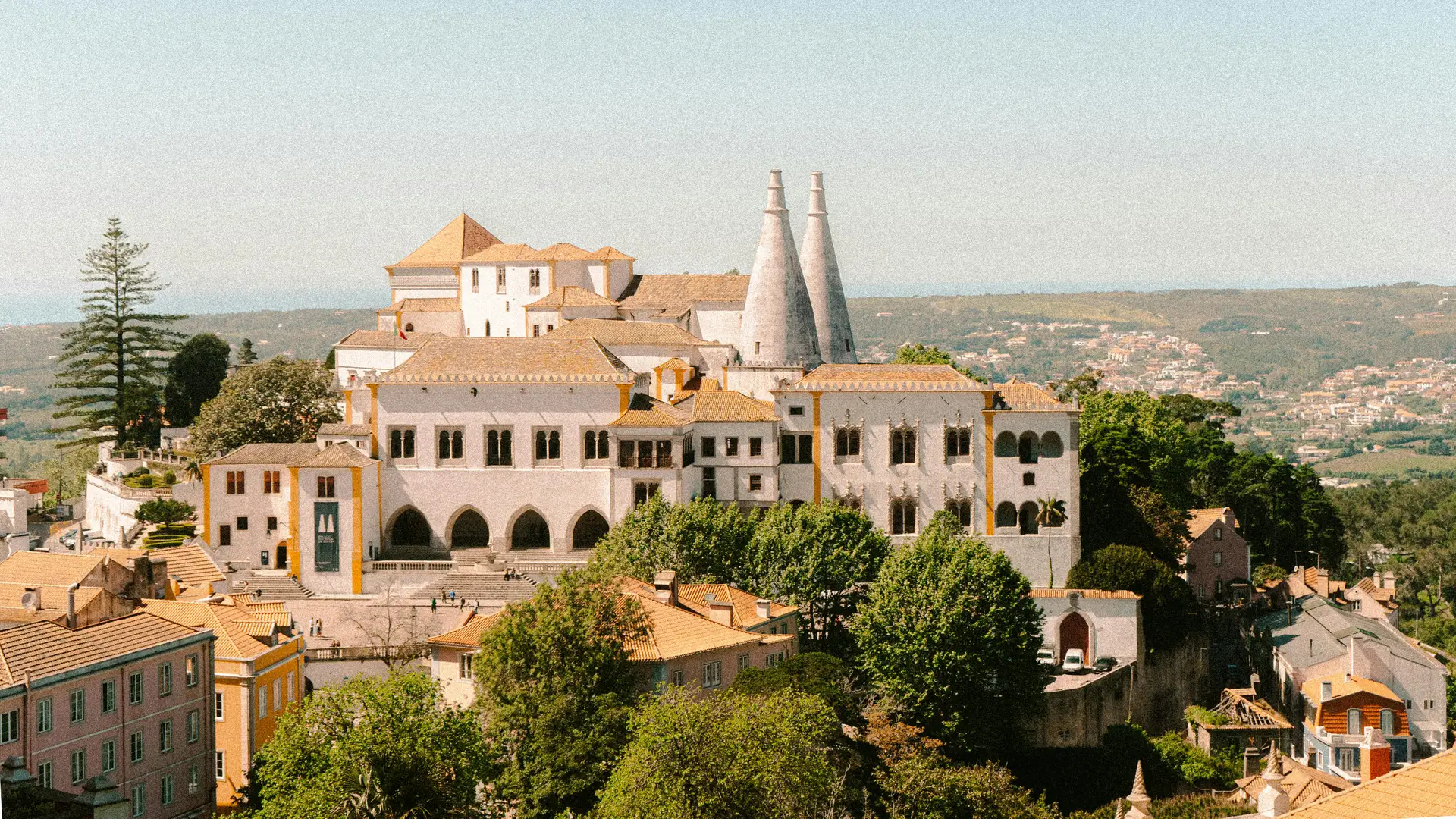
Visitors who reach Sintra for the first time are often surprised to find that the town holds two completely different palaces, each justifiably famous, separated by less than three kilometres on the map but by six centuries in spirit. Palácio Nacional de Sintra is the older, medieval-into-Manueline royal residence sitting flat in the village centre beneath its iconic twin kitchen chimneys, the most-occupied royal residence in Portuguese history. Palácio da Pena is the 19th-century Romantic hilltop fantasy commissioned by King Ferdinand II, all yellow towers, red bastions and Moorish-revival flourishes, perched on a wooded ridge 480 metres above sea level. They are not substitutes for one another — they are different epochs, different ambitions, and different physical experiences — and the smart visitor sees both. This concierge guide compares them fairly across history, architecture, terrain, time required, and ideal sequencing for a single Sintra day.
Two palaces, six centuries apart
Palácio Nacional de Sintra traces its core to the Moorish period and was first significantly refurbished as a Portuguese royal residence by King Afonso IV in the 1280s, then dramatically expanded by King João I in the late 14th century and again by King João II in 1495. Its architectural vocabulary is medieval and Manueline-mudéjar — pointed arches, intricate Hispano-Moorish geometric tilework, painted wooden ceilings, and the famously functional twin chimneys above the medieval kitchen. The building was a working royal residence continuously from the medieval period through the fall of the monarchy in 1910, a span of occupation no other Portuguese palace can claim.
Palácio da Pena, by contrast, is a 19th-century creation, built between 1842 and 1854 by King Ferdinand II on the ruins of a Hieronymite monastery, and is one of the foundational monuments of European Romanticism. Ferdinand was a German prince married into the Portuguese crown, and he conceived Pena as a deliberately eclectic Romantic manifesto in stone — Neo-Manueline, Neo-Moorish, Neo-Gothic and Renaissance motifs fused into a single fantastical silhouette painted yellow and red. Visiting both palaces in one day gives you 600 years of Portuguese royal life in a single afternoon — an architectural and emotional contrast that few destinations in Europe can match in such a compact geography.
Architecture and atmosphere: restraint versus theatre
Inside the National Palace the dominant sensation is layered restraint. Whitewashed walls carry centuries of tile, ceilings open into masterpieces of painted heraldry (the Swan Room with its 27 swans, the Magpie Room with its punning legend, the Coats of Arms Room with 71 Portuguese noble families), and the medieval kitchen, with its conical chimneys soaring 33 metres overhead, is one of the most theatrical functional spaces in European architecture. The visit moves through human-scale rooms rather than vast staterooms, and the architectural pleasure is in the layering of Moorish, Manueline and Baroque additions you can read on adjacent walls.
Pena, by contrast, is theatre from the outside in. Its silhouette of yellow towers and red ramparts is designed to be seen from a distance against the Sintra mist; its interiors mix Neo-Gothic, Neo-Manueline, Neo-Islamic and even chinoiserie influences with an unapologetic 19th-century flamboyance. The terraces and battlements around the palace are integral to the experience — Pena was conceived as a walked landscape rather than a building alone, and the surrounding Park of Pena was planted with thousands of exotic species under Ferdinand's botanical eye. National rewards slow looking and quiet attention; Pena rewards photography and the long view.
Terrain, effort and time required
The two visits could not be more different physically. The National Palace sits in flat, pedestrianised Sintra village, a three-to-five-minute downhill walk from the train station, with no shuttle buses, no significant climbing inside (a few staircases between floors), and accessible cobbled streets. Pena Palace, by contrast, occupies a hilltop 480 metres above the village; reaching it requires a 434 bus, tuk-tuk or taxi up steep wooded switchbacks, followed by a steep walk or shuttle from the park entrance to the palace gate itself, and the visit involves continued climbing inside grounds and terraces. Visitors with mobility considerations, young children or limited stamina handle the National Palace easily; Pena demands realistic conditioning.
Plan 60 to 90 minutes inside the National Palace for a relaxed visit covering the major rooms and the kitchen. Pena typically demands 2.5 to 3.5 hours when you include the journey up, the palace interior, the terraces, and ideally a wander into the Park of Pena around it. Crowd patterns also differ: the National Palace shares its bottleneck with the historic centre of Sintra (worst from 11:00 to 16:00 on weekends), while Pena has its own dedicated crowding curve driven by shuttle bus capacity and the 434 bus from Sintra station, with the worst hours similarly being late morning to mid-afternoon. The smart trick is to front-load the National Palace at 09:30 opening and reach Pena around 11:00 once you are already on the hill.
Verdict: see both, in the right order
If you only have a single Sintra day, the strongest itinerary is unambiguous: open the day at the National Palace at 09:30, spend 60 to 90 minutes inside, then transfer up to Pena and the Moorish Castle for the middle of the day, and return to the village in the late afternoon. This sequence respects the historical chronology (medieval to 19th-century Romantic), the physical effort gradient (flat first, hill second), and the crowd curve (you reach the village before the day-trip wave and the hilltop just as it crests). Both palaces are managed by Parques de Sintra-Monte da Lua (PSML), which simplifies combined ticketing into a single concierge transaction.
If you genuinely must choose only one, the answer depends on your taste. History-first visitors choose the National Palace, because it holds the longer story and the more layered interiors. Photography-first and Romanticism-curious visitors choose Pena, because its silhouette is the famous Sintra image and its terraces deliver the long views. Travellers with mobility considerations, very young children, or limited stamina should choose the National Palace without hesitation — flat village location, no shuttle, no terraces. Your concierge can assemble combined tickets covering both palaces and the Moorish Castle, with pre-arranged transfers up the hill if you prefer not to manage the 434 bus or queue for a tuk-tuk.
Frequently asked
Which is older, Sintra National Palace or Pena Palace?
The National Palace is far older, with medieval origins and major Portuguese royal works from the 14th and 15th centuries. Pena is a 19th-century Romantic-era construction.
Are they near each other?
Less than three kilometres apart, but Pena sits on a 480-metre forested ridge while the National Palace is flat in the village centre.
Can I visit both in a single day?
Yes — most visitors do. The recommended order is National Palace first thing, then Pena and the Moorish Castle for the middle of the day.
Which one is more physically demanding?
Pena is significantly more demanding due to the hilltop location, the shuttle logistics, and the continued climbing inside. The National Palace is flat and short-walking.
Which has better photography?
Pena is more photogenic from the outside thanks to its dramatic Romantic-era silhouette. The National Palace has spectacular interiors (Swan Room, Magpie Room, Coats of Arms Room).
Which one tells more Portuguese history?
The National Palace, by a wide margin — it was the most-occupied royal residence in Portuguese history and spans the Moorish, medieval, Manueline and modern eras.
Is one more expensive than the other?
Each has its own admission, and combined tickets covering both (often with the Moorish Castle) typically work out cheaper than buying singles.
If I only have time for one, which should I choose?
History-first visitors choose the National Palace; photography-first or Romanticism-curious visitors choose Pena. Either is a complete visit on its own.
Are both run by the same operator?
Yes. Both palaces are managed by Parques de Sintra-Monte da Lua (PSML), which simplifies combined ticketing.
Which is better for travellers with mobility considerations?
The National Palace, clearly. Flat village location, no shuttle, no significant climbing — versus Pena's hilltop, shuttle and terraces.