 Skip-the-line available
 How to Get to Sintra National Palace from Lisbon
Palácio Nacional de Sintra is the easiest of all Sintra's major monuments to reach from Lisbon, because — unlike Pena Palace on its forested ridge — it sits flat in the heart of Sintra's historic centre, a three-to-five-minute downhill walk from Sintra train station. The fast, cheap and crowd-resistant route is the Linha de Sintra commuter train from Lisbon's Rossio station, a 40-minute ride, followed by a short walk through the cobbled main square. Tuk-tuks, horse carriages, taxis and rideshares are available at the station, but for the National Palace specifically they are slower and more expensive than your own two feet. This concierge guide covers every realistic way in, with timings, the small mistakes that catch first-time visitors out, and how to integrate the National Palace into a return-journey itinerary that also takes in Pena Palace and the Moorish Castle.
The train from Lisbon Rossio: the default route
The Linha de Sintra commuter train runs from Lisbon's Rossio station to Sintra station in roughly 40 minutes, with departures typically every 20 minutes on weekdays and every 30 minutes on weekends. Rossio is the most central of Lisbon's main rail terminals, set on the edge of Baixa within walking distance of Praça do Comércio, Chiado, and the Avenida da Liberdade hotels. Tickets are sold from machines and counters in the station for a flat low-cost fare; the same Viva Viagem rechargeable card you use on the Lisbon metro works on this line. Trains also stop at Lisbon Oriente for travellers staying near Parque das Nações, and at Entrecampos and Sete Rios for those on the city's northern axis. Sintra is the final stop on the line, so you cannot miss it: the train empties out and the conductor announces it clearly.
The Sintra line is operated by Comboios de Portugal (CP) as a suburban service rather than a tourist train, which is part of why it is so efficient. Trains begin running before 06:00 and the last departure back to Lisbon typically leaves Sintra around 23:00, so even a late-afternoon return is unhurried. Standard practice is to buy a return when you arrive at Rossio — the machines display English-language prompts and accept contactless cards — and tap the same Viva Viagem card on both legs. Bicycles are permitted in marked carriages on weekends, which suits travellers continuing from Sintra to Cabo da Roca or the Atlantic beaches afterward. The line is reliable in all but the worst weather and rarely sees the disruption common to longer-distance Portuguese rail.
From Sintra station to the palace: a short downhill walk
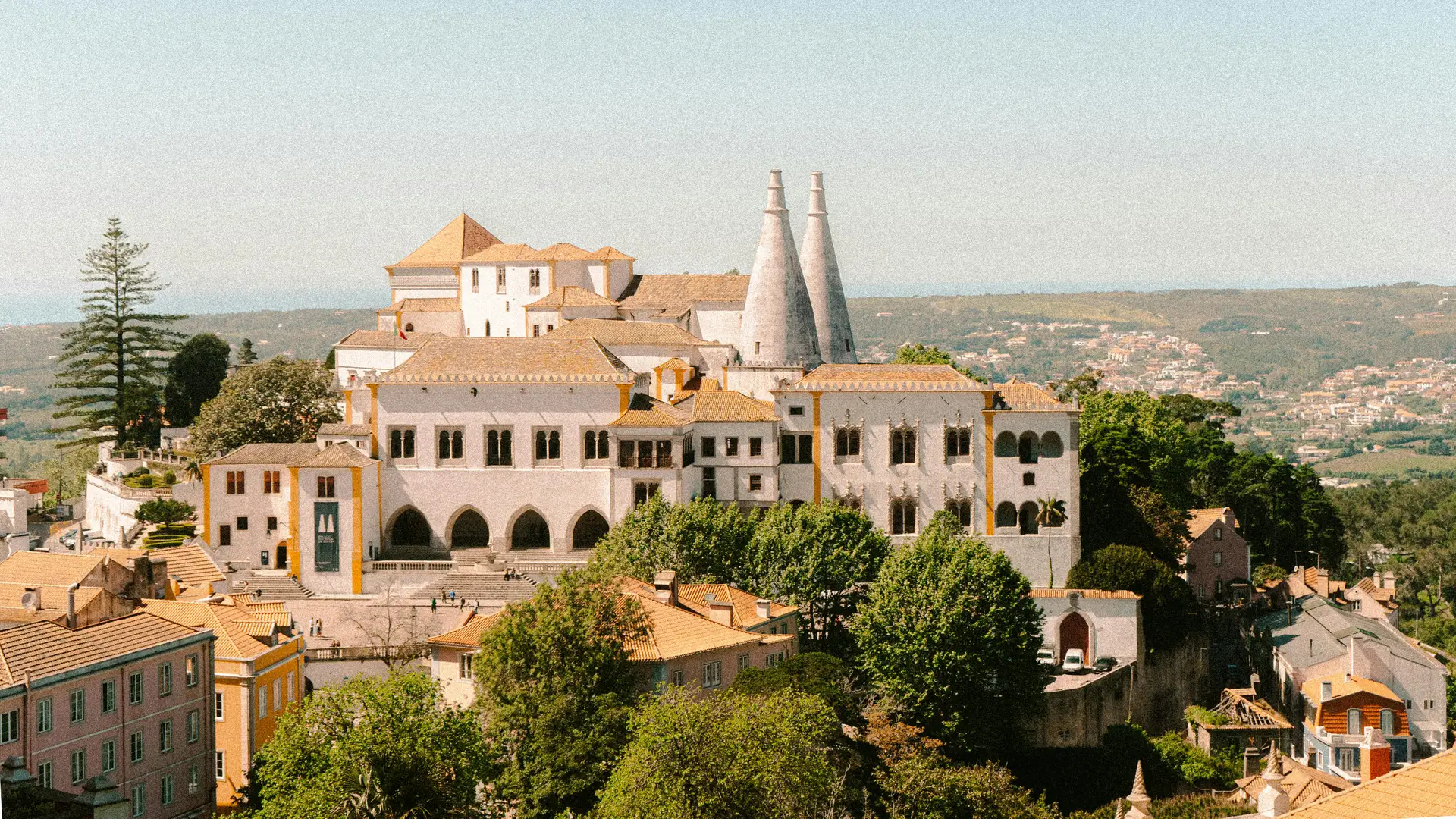
Sintra train station sits at the edge of the historic centre, slightly uphill from the village core. Leaving the station you turn right along Avenida Dr. Miguel Bombarda, then bear gently downhill along the cobbled main street into the historic centre, and the palace announces itself unmistakably: two great conical white chimneys, 33 metres tall, rise from the medieval kitchen and dominate the village skyline. The walk is three minutes at a brisk pace, five at a leisurely one, mostly downhill on the way to the palace and very gently uphill on the way back. Unlike Pena Palace — which sits on a 480-metre wooded ridge and requires a 434 bus or tuk-tuk to reach — the National Palace is genuinely walkable from the train and has no transfer logistics to manage.
The cobbled main street is partially pedestrianised and shared with slow-moving tuk-tuks, so families with small children or travellers with strollers should keep right. There are no significant steps along the route and the gradient is moderate, but the cobbles themselves are uneven and worn smooth in places, which calls for sensible footwear. Sintra's tourist information point sits in the small square near the palace gate and is a useful stop for paper maps of the wider Cultural Landscape if you intend to continue up to Pena or across to Quinta da Regaleira afterward. Public toilets, ATMs and a CTT post office are all within two minutes of the palace entrance, and the same square holds the historic Casa Piriquita pastry house famous for the travesseiro and the pastel de Sintra.
Stitching the day together: National Palace, Pena, Moorish Castle, return
A well-paced day from Lisbon looks like this: catch an early Rossio train arriving in Sintra around 09:00–09:15; walk down to the National Palace for the 09:30 opening; spend 60 to 90 minutes inside; then transfer up the hill by 434 bus, tuk-tuk or rideshare to Pena Palace, followed by the Moorish Castle, allowing roughly four hours combined for the two hilltop sites; return down to the village in the late afternoon for a pastel de Sintra at one of the historic cafés, then back to the station and an early-evening train to Lisbon. The total day runs around 9 to 10 hours from your Lisbon hotel and is comfortable for most visitors. Your concierge will assemble the appropriate combined ticketing and any transfers.
If you have less time or want a lower-effort day, the National Palace alone is the strongest standalone choice because it requires no shuttle, no hill climb and no transfer logistics. A half-day plan looks like a mid-morning Rossio departure, a relaxed 90-minute palace visit, a lunch on the main square, and a return train by mid-afternoon — three and a half to four hours from your Lisbon hotel. If you are travelling with older relatives or young children for whom the Pena hill climb would be punishing, this half-day variant captures genuine Sintra without the logistics. Adding Quinta da Regaleira, ten minutes' walk from the National Palace, lengthens the day modestly and is the natural pairing if you want a second site without the hill.
Frequently asked
How long is the train from Lisbon to Sintra?
Roughly 40 minutes from Rossio station to Sintra, with departures every 20 minutes on weekdays.
Which Lisbon station should I leave from?
Rossio is the most central. Oriente, Entrecampos and Sete Rios are alternatives if you are staying nearer those neighbourhoods.
How far is the palace from Sintra train station?
Three to five minutes on foot, mostly downhill, through the historic centre. You can see the twin chimneys from the station approach.
Do I need to take a bus from the station?
No, not for the National Palace. Buses (the 434 in particular) are useful for reaching Pena Palace and the Moorish Castle on the hilltop.
Can I drive from Lisbon and park near the palace?
Driving is possible but strongly discouraged. Parking in the historic centre is severely limited, often impossible on weekends, and slower door-to-door than the train.
Are tuk-tuks worth the cost from the station?
Not for the National Palace itself — the walk is too short. Tuk-tuks become useful for the onward climb to Pena and the Moorish Castle.
Is the route suitable for travellers with mobility considerations?
The walk is short and on cobbles. Travellers with mobility needs may prefer a tuk-tuk or taxi from the station directly to the palace gate.
What is the cheapest way to get there?
The Linha de Sintra train from Rossio, paid via Viva Viagem card, then a free walk to the palace gate.
Can I combine the journey with Pena Palace in the same day?
Yes, and most visitors do. Start at the National Palace at opening, then take the 434 bus or a tuk-tuk up to Pena and the Moorish Castle for the middle of the day.